

What is the 1737 plaque at the crossing marking?
A lucky visitor who is here when the central altar is moved out of the way will see an inscription “AD 1737 The Center (sic) of the Tower”.
This was installed by Francis Price, who was re-creating an experiment suggested by Christopher Wren, to “plumb” the spire, that is, to drop a plumb line from the inside of the top all the way down to the cathedral floor.
In Francis Price’s own words:
“Sir Christopher directs, in his Survey of 1668, to remove some of the timbers in the tower, and spire, that a plummet might be let fall from the highest part possible, to the pavement at once; and that this trial were often repeated, at some distance of time, to see if it continue in its decline.
“In 1681, Mr. Thomas Naish (then clerk of the works) and since that, Mr. William Naish, in the same office, used a particular method in trying this experiment, viz. after many trials they fixed a staple near the weather door, in the north-east angle of the octagon, which doubtless was the highest part manageable for the principal timbers. At the middle and outside of this staple, the line, with a plummet of sufficient weight, was let down to the pavement at once, and there the centre of the plummet was marked upon the said pavement, for future repetition. This was the most simple and easy way, by which to keep a register. Both these gentlemen concluded from their trials, that there has been no change in the declination.
“In 1736, the late Mr. Naish tried the same experiment, and found all as usual.”
After a discussion of an alternative method, Mr Price continues:
“I think [this] method used by Mr. Naish and his father, is most to be relied on, till accidents shall hinder the application of it. Their remarks being made upon the common pavement of the church, my lord bishop thought it might be the better way to take all possible care of, and remark the point of the plummet’s centre, that it might be transferred to a stone of more substance, with a foundation brought up from the natural soil to rest upon, as thereby less subject to be moved.
“And in taking the necessary care, it was thought the best way to find the true centre of the building, or rather of the grand legs, which it was easy to measure from the square parts of the marble bases, that stand clear and measurable in the north and south aisles. These lines being drawn, so as to point out the true centre of the grand legs, the centre of the aforesaid plummet falls to the north two inches and a quarter, and to the east seven inches and a half. This may be a guide in times to come, and to mark it the better, there are holes drilled into the marble steps leading up in to the choir, as likewise on the old marble tombs to the westward. There are likewise holes drilled into the common pavement, north and south, which may become a guide while the pavement remains in its present situation.
“By these means the new stone was fixed, and on November 3, 1739, the late Mr. Naish tried the usual experiment, and found no variation; therefore a brass pin is inserted in the new stone, where the centre of the plummet did usually fall. This will remain a sufficient direction for future observation; and it serves to show, that there has not been the least increase of the declination, during the space of fifty-eight years, viz. since the first observation was made.”
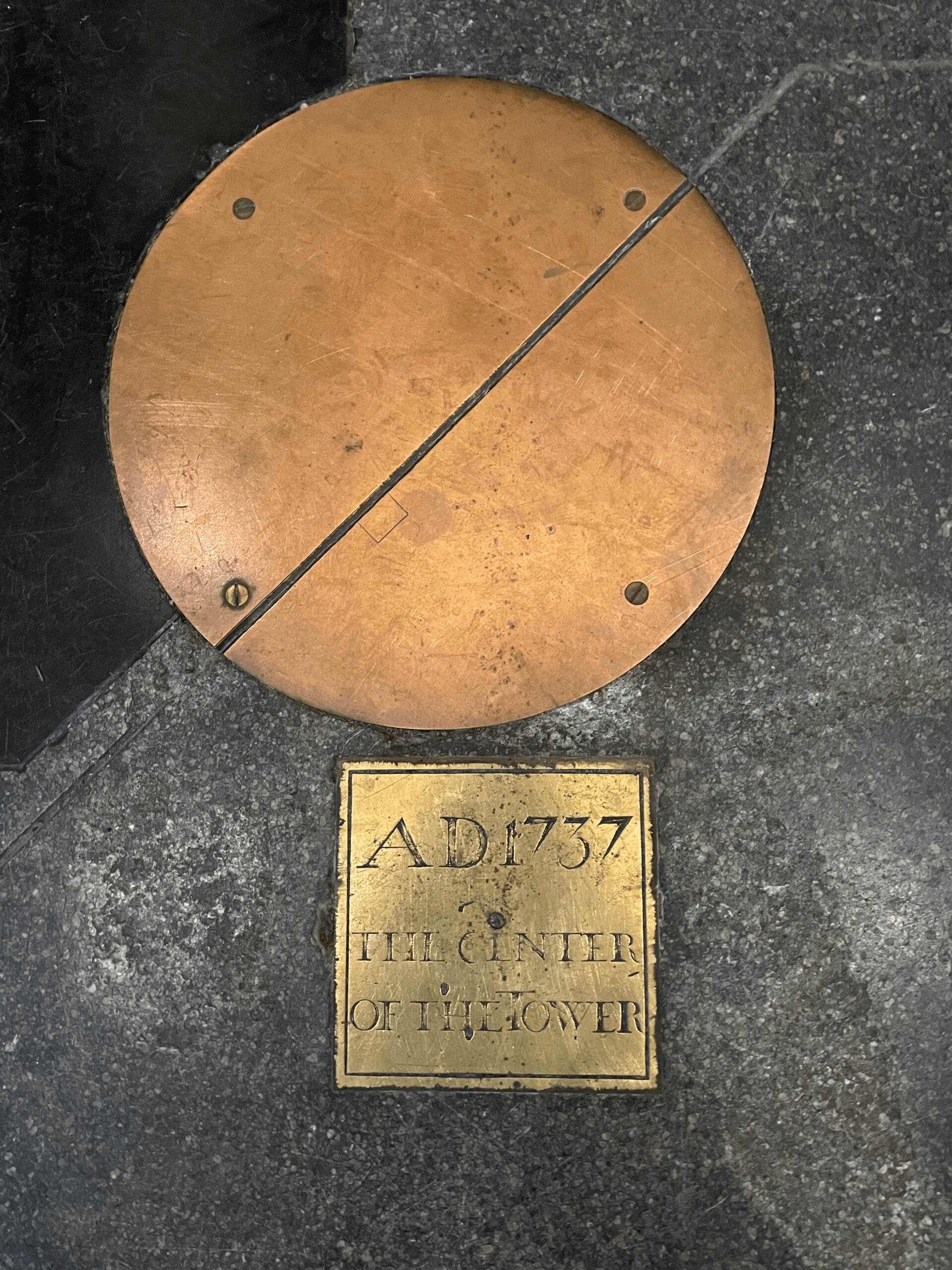
And here indeed we have the Center of the Tower (the mark in the middle of the square) and, 2 ¼ ” N and 7 ½” E, a little picture of the staple attached to an octagon, which is the size of the spire inside the weather door.
Which may lead you to some further questions:
Why did Christopher Wren survey the cathedral?
What other methods have people tried to measure the spire’s lean?