

Why do you have cloisters if you didn’t have monks?
I mean, they are very pretty but why put in all that effort if you’re not going to use the space.
When the Sarum story opens, there were around 20 dioceses in England and Wales, mostly set up in the 600s (yes! things did happen in Britain between the Romans leaving and William the Conqueror arriving!) and the bishops’ seats (called cathedras) were in a fairly even mix of monastic and secular cathedrals.
As part of William’s re-organisation of the British church, the dioceses of Sherborne and Ramsey were merged to form the new diocese of Salisbury and in 1078 his Chancellor Osmund took a sideways move from working on the Domesday project to become its bishop. Previously the cathedra had been in Sherborne Abbey, which was monastic. Osmund was learned and chaste and very keen on order but he was not a monk. His cathedra was going to be based at (Old) Sarum, and so he led the project to build a fine new secular church for it.
One of the things that he did do, which is very important to our story, is that he developed the Rite of Sarum which spelled out the various processions required in different services. And some of those – yes! – required going out into the cloisters, so the cathedral churches at Old Sarum and then at New Sarum were built with cloisters.
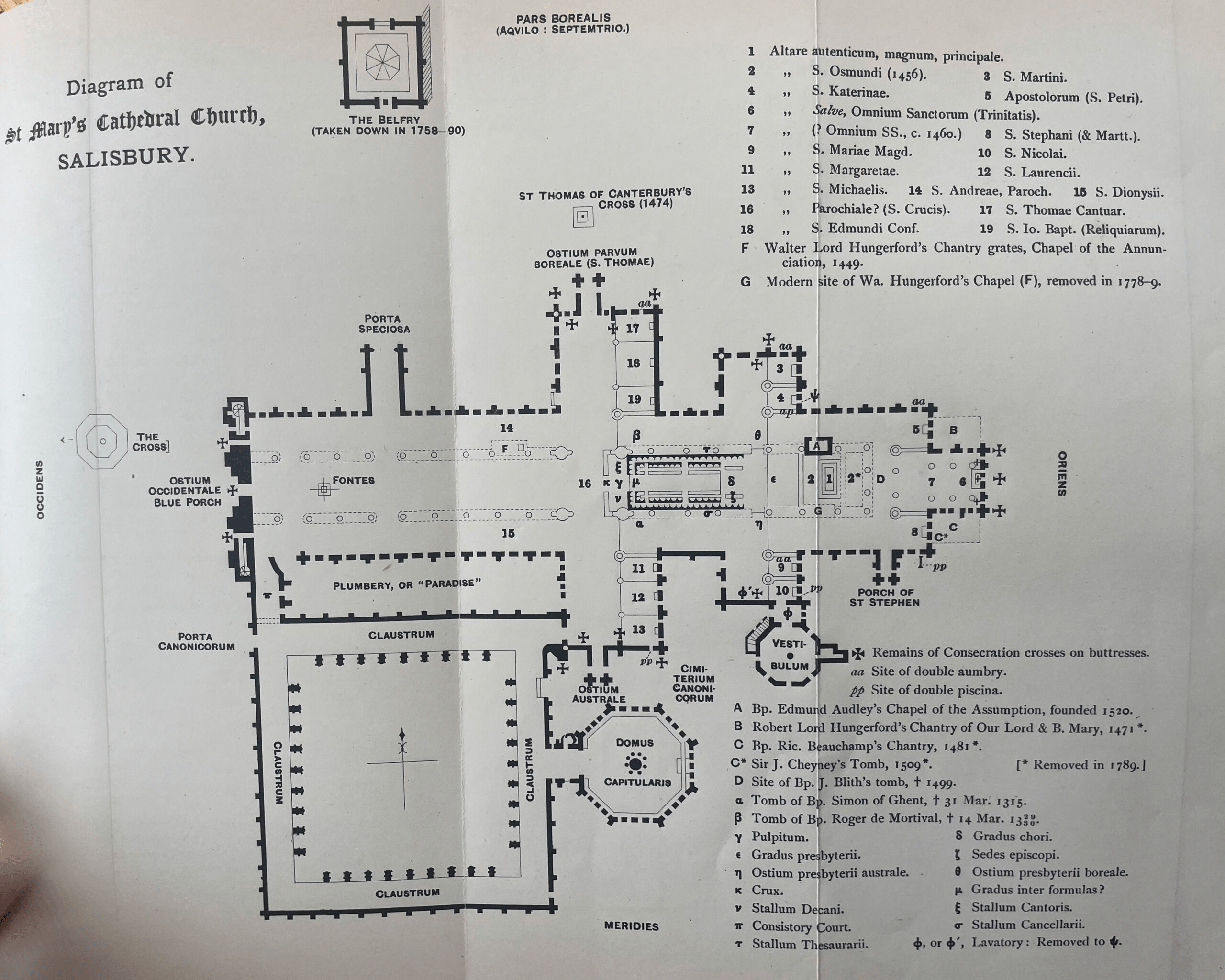
Here is a reconstruction of the original layout of the current cathedral, done by Christopher Wordsworth in his book “Salisbury Ceremonies and Processions”.
Another point about Osmund is that he was very keen on books, and built up a large library at the cathedral, reputedly even writing, illuminating and binding some of them himself. In “The Medieval Scriptorium”, Sara Charles develops the theory that the cloisters contained carrels or study rooms – still observable in Gloucester Cathedral – offering a perfect combination of shade and light for writing and illuminating. So although Osmund’s priests didn’t live the monkish “life in common” they may still have enjoyed having a quiet place to work on their manuscripts between services, or to study books too.
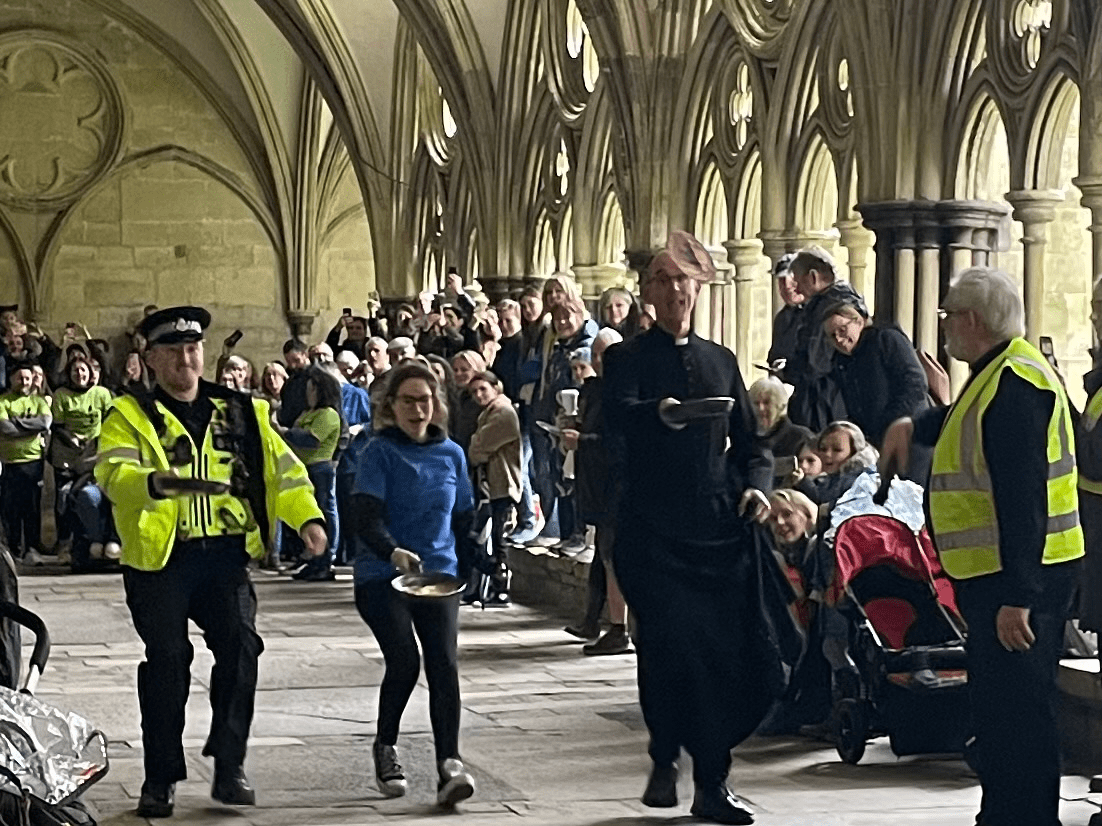
PS It is entirely coincidental that the cloisters are the perfect shape for pancake day races.
Questions arising from this might include:
- Were our cloisters ever used for other things?
- What has changed in the cathedral from the original layout?
- What happened to Osmund’s library?
1 thought on “Why do you have cloisters if you didn’t have monks?”
Comments are closed.