

Where are the monks?
When our visitors are told our cloisters are the largest in the UK it is reasonable that they ask “So where are the monks now?”
The standard guides’ answer is “We never had monks because our cathedral was secular, not monastic” although this just generates the very reasonable question “What is the difference between a secular and a monastic cathedral? And why did they have both types?”
The answer lies back in the earlier days of the Christian Church. Christianity came to England by three routes – through the Roman Empire, then from monks arriving from Ireland and then from missionaries arriving from Gaul.
Originally followers of the Christian Church were encouraged to live a life “in common”, that is, with only shared possessions and spaces. The Rules laid down by Augustine for his community in Hippo (Algeria) in the late 4th century defined a precise and very austere daily timetable, with activities focused inwards into the community and celibacy required. As the church expanded into the developing economic areas of Gaul and then England, the Benedictine monks established a way of living in common which could fit more easily into a feudal society.
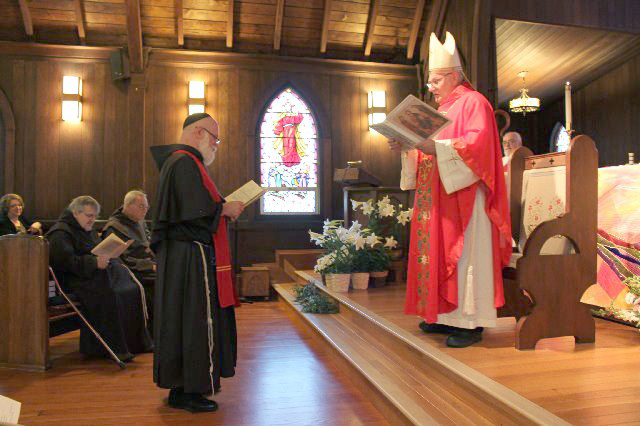
Going into the time of the Conquest (mid-late 11th century) the need to provide canons to fit in with the growth of towns and the expansion of education and to provide trained clerks for court administration meant that a more independent way of life would be needed for some of the clergy. The full “secular” system allowed individual possessions and incomes and allocated individual estates or prebends to individual canons, and the requirement for celibacy was increasingly ignored.
A cathedral could decide to move between different systems, including moving back to being run by monks. In the early English cathedrals of Canterbury, Exeter, Wells and Hereford the “common life” with a refectory and a dormitory was re-introduced for the lower clergy although more senior clergy could still have their own houses and incomes.
William the Conqueror appointed his counsellor Lanfranc as Archbishop of Canterbury after the Conquest and instigated a major reorganisation of the English church (referred to as the Council of London). Perhaps partly due to Lanfranc’s own background as a Benedictine monk – and in the face of opposition from some of William’s bishops – he encouraged more cathedrals to keep or return to the monastic method, ending up with ten monastic cathedrals and nine secular ones (see lists at the bottom of this post).
The knotty problem of clerical celibacy remained unresolved, by the way.
So to answer the question: In a monastic cathedral, the cathedral is run by the head monk, the prior or abbot, taking on the additional job of Dean. In a secular cathedral, the Dean is the most senior priest. “Secular” nowadays means not-religious, but back then (when everything was religious) it meant not-choosing-to-be-a-monk, so the Dean is a proper priest who has chosen not to join one of the monastic orders.
Which inevitably leads to some more questions:
- Why do you have cloisters if you didn’t have monks?
- Were there any monks in Salisbury?
- Can you tell me more about the different orders of monks?
Finally, a couple of lists, for people who like lists:
- The secular cathedrals:
- Chichester
- Exeter
- Hereford
- Lichfield
- Lincoln
- London
- Salisbury
- Wells
- York
2. The monastic cathedrals:
- Bath
- Canterbury
- Carlisle
- Coventry
- Durham
- Ely
- Norwich
- Rochester
- Winchester
- Worcester
And for a bonus extra point in a rather specialist pub quiz, the monastic cathedrals were all Benedictine except for Carlisle which was Augustinian.