

Is that holy water in the font?
Many of our Catholic visitors cross themselves with the water running out of our font – but is it actually holy water?
There turn out to be some very specific rules about fonts in the Church of England’s Canon Laws. In fact, there are very specific rules about just about everything, so be careful when clicking on that. Or if you do, force yourself to scroll past the sections “On The Royal Supremacy” and “On Schisms” until you reach Canon number F1, “On Fonts”.
Where we find:
1. In every church and chapel where baptism is to be administered, there shall be provided a decent font with a cover for the keeping clean thereof.
2. The font shall stand as near to the principal entrance as conveniently may be, except there be a custom to the contrary or the Ordinary otherwise direct; and shall be set in as spacious and well-ordered surroundings as possible.
3. The font bowl shall only be used for the water at the administration of Holy Baptism and for no other purpose whatsoever.
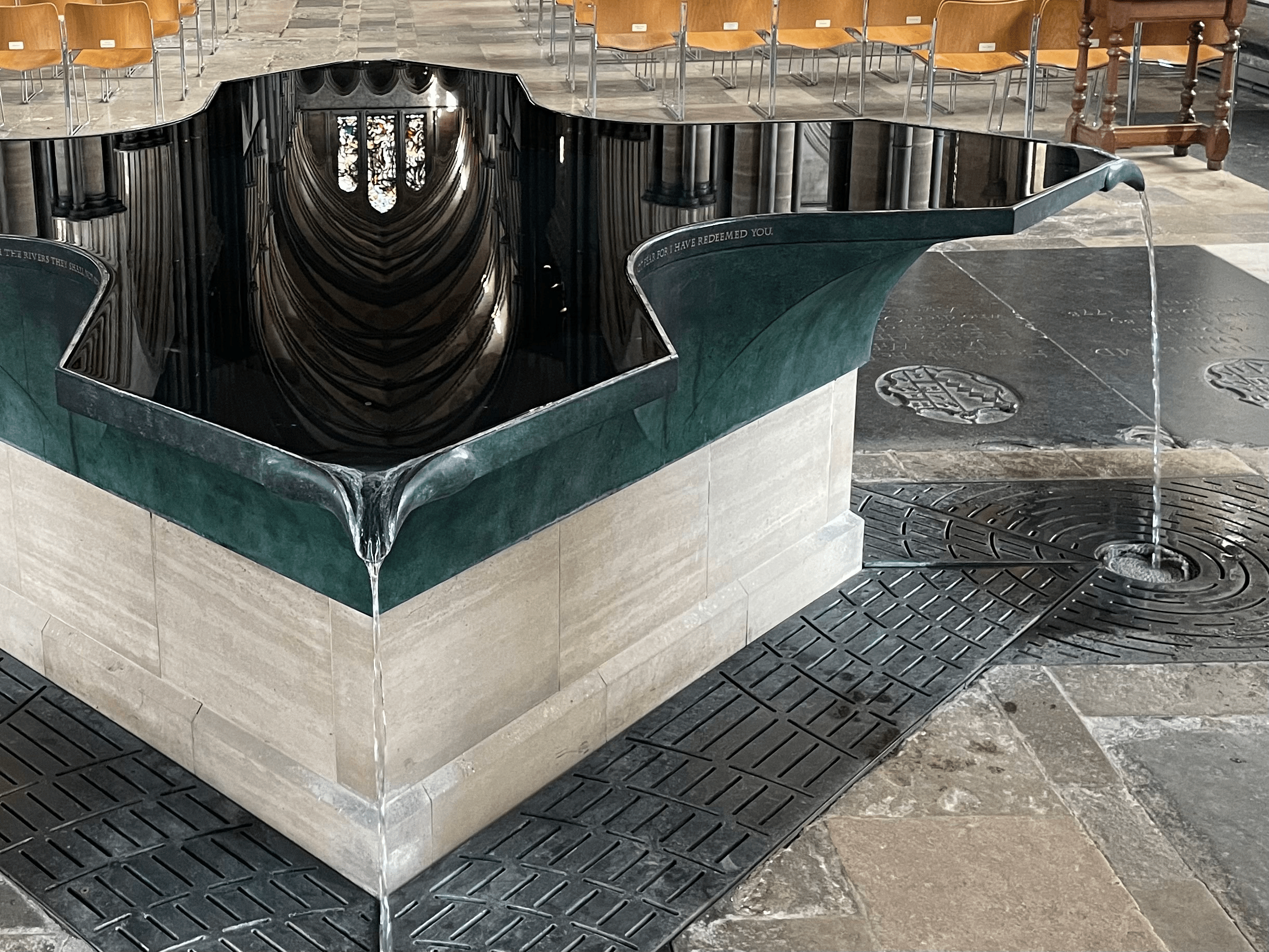 Well this is very interesting. and Salisbury gets a big tick for point number 2, but where is the cover? What about the water?
A conversation with the cathedral staff discovers that the font has a secret drainage pipe which leads out into the central part of the cloisters, so that the water blessed for a baptism can be drained afterwards onto consecrated ground and replaced with eau de tap until it is next needed. So although what you are seeing here is water on holy ground, it is not technically holy water unless you are actually at a baptism.
You may notice that fonts in parish churches have a little plug at the bottom so that the water again can be drained out onto consecrated ground… but no, you won’t notice that, because all the fonts have covers on them, see point number 1.
So how did Salisbury get permission to have an uncovered font?
Some digging around reveals an application for the nearby church of St Thomas in 2023 to install a new, uncovered font in the centre of the church, replacing their old Victorian one. The judgement from the Salisbury Bishop’s Consistory Court makes interesting if slightly long-winded reading but a determined reader will eventually reach paragraph 40 which references Salisbury Cathedral’s font:
“However, there are examples of uncovered fonts namely in Salisbury Cathedral, in Portsmouth Cathedral and in the Church of the Resurrection at Mirfield. In all of these cases the font was designed as a piece of sculpture as well as being a font and the sculptural element meant that a cover was not deemed to be desirable or practicable…
“There can be practical issues which arise from having an uncovered font. When the font was first installed at Salisbury Cathedral for example visitors used it rather as a wishing well which meant that the vergers had to regularly go fishing for coins.”
And indeed the vergers tell me that the coins were a problem, particularly with parties of visiting Italian schoolchildren, and they now have a special shrimping net to get the coins out.
The writer of this document is a bit sniffy about not knowing where Salisbury Cathedral actually got its permission from, implying that they seem to have been bypassed somehow.
So once again we seem to have uncovered more questions than answers:
Why is there a Canon on Royal Supremacy?
Why is there a Canon on Schisms?
What did they find when they installed the font?
What is a Consistory Court?
Why is there a rule that fonts should be covered?